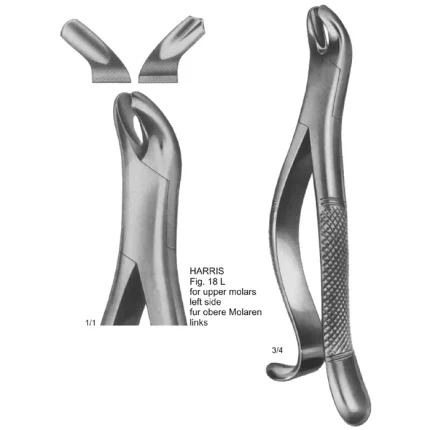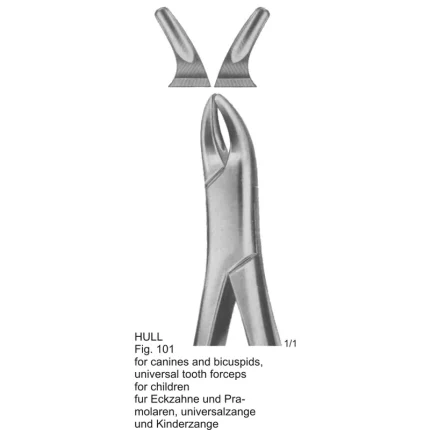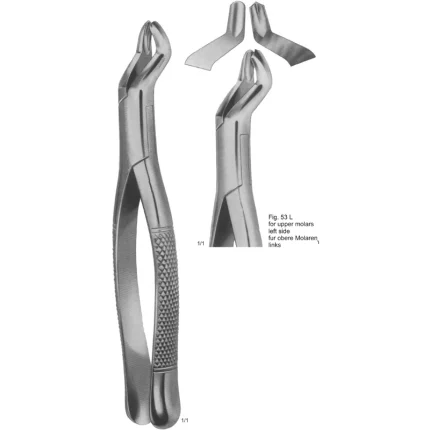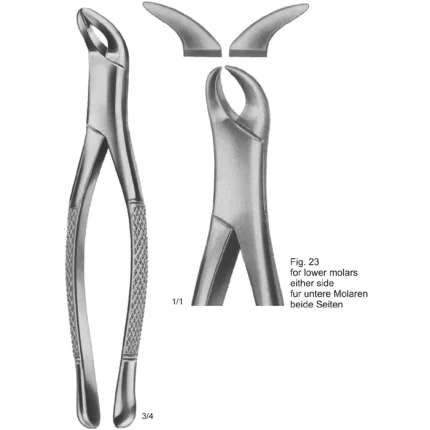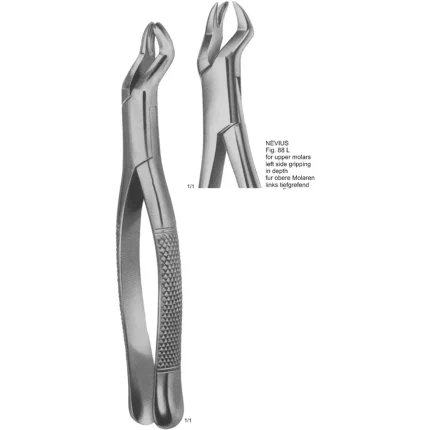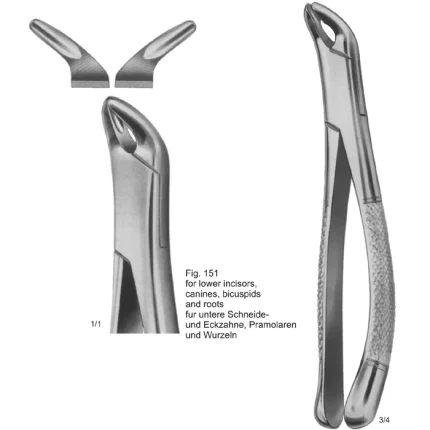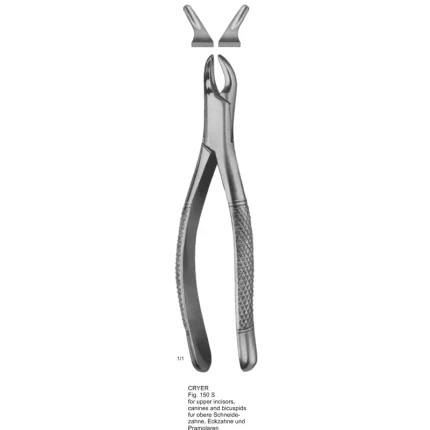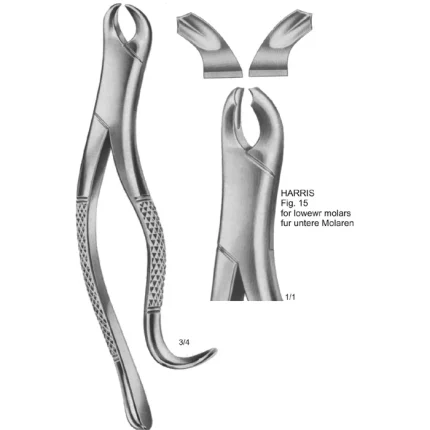
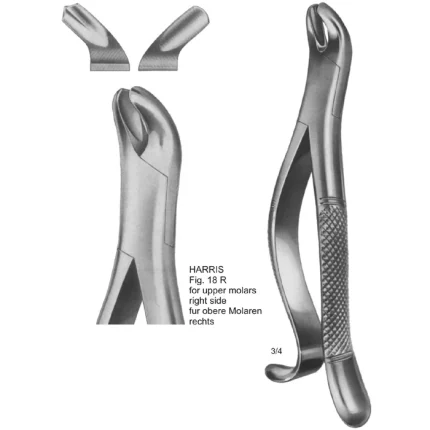
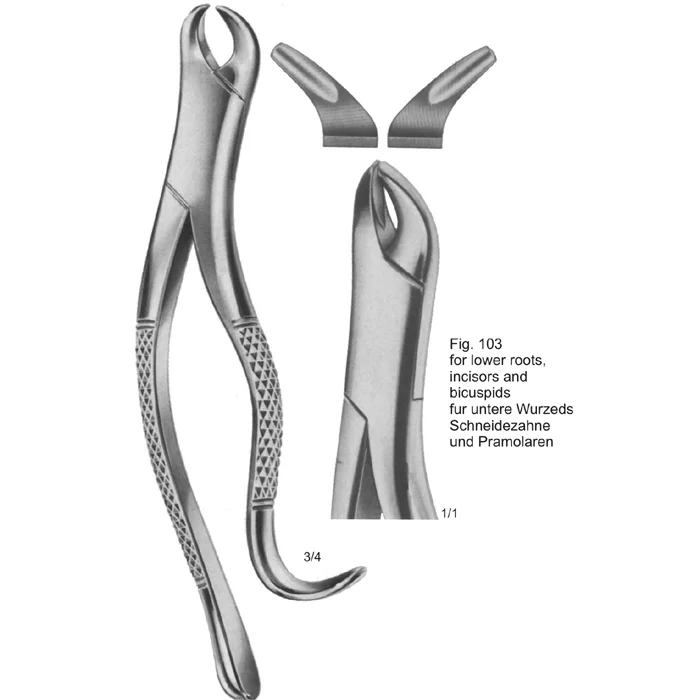
Tooth Extracting Forceps (American Pattern)
The ASI-2166 Tooth Extracting Forceps is a general-purpose extraction instrument built by Aero Surgical Instruments in Sialkot, Pakistan, using premium German stainless steel. It’s aimed at dental clinicians who want a dependable American Pattern forceps capable of handling routine extraction work day after day without losing its edge, grip, or hinge precision.
The steel used in this instrument is chosen specifically for surgical applications: it holds up under repeated rotational and lever forces without deforming, and its chromium content protects the metal from rust and corrosion across years of clinical use. That combination of hardness and corrosion resistance is what lets a hand instrument like this survive hundreds of sterilization cycles while still closing with the same tight, predictable action it had on day one.
Following American Pattern conventions, the beak tips are shaped to seat closely against tooth crowns and roots, giving the clinician broad, even contact rather than a narrow pinch point. That wider contact area matters because it spreads extraction force across more of the tooth surface, which helps reduce the chance of fracturing the tooth or over-stressing the periodontal ligament during elevation. The beak curvature is also designed to work its way toward the gingival margin cleanly, supporting a secure subgingival hold before force is applied.
Externally, the instrument carries a dull matte finish rather than a bright polish. This is a deliberate choice for surgical settings: under strong operatory lighting, a highly reflective surface bounces glare back toward the clinician’s eyes at exactly the moments when precise visual judgment is most needed. The matte coating cuts that glare down and also tends to resist smudging and water spotting between uses.
The handle is knurled for grip security, a detail that matters most when hands are inside latex or nitrile gloves that may be damp with saliva, blood, or irrigation fluid. Along with a deliberately balanced weight distribution along the shaft, the handle design is intended to reduce hand and wrist fatigue over a full clinical day while still preserving the tactile feedback a clinician needs to judge how a root is responding to applied force.
Internally, the hinge is fitted to move with minimal play or friction, so opening and closing stays smooth and consistent rather than developing looseness or sticking with age. A well-aligned hinge also helps keep the beak tips meeting evenly, which is part of what prevents slippage under load. The joint area is shaped to avoid trapping debris, so ultrasonic cleaning and standard chemical disinfection protocols can reach and clear it fully between uses.
Sized to standard dental cassette and tray dimensions, the ASI-2166 slots into existing instrument sets without special accommodation, and each unit reportedly passes dimensional and joint-alignment inspection before it leaves the factory. It’s positioned as a solid everyday extraction forceps suited to general dentistry and oral surgery practices handling a broad mix of routine cases.
Frequently Asked Questions
- What material is the ASI-2166 made from? German-grade stainless steel selected for strength and corrosion resistance.
- What pattern does this forceps follow? The American Pattern design tradition, with beak geometry suited to broad tooth contact.
- Who makes this instrument? Aero Surgical Instruments, manufactured in Sialkot, Pakistan.
- What finish is applied to the surface? A dull, non-reflective matte finish rather than a polished chrome look.
- Why does a matte finish matter in surgery? It reduces glare from bright operatory lights, helping maintain clear visual focus.
- Is it autoclave-safe? Yes, the steel withstands repeated high-heat steam sterilization cycles without warping.
- Can it be cleaned in an ultrasonic bath? Yes, the joint design lets ultrasonic vibration clear debris from the hinge area.
- How does the handle prevent slipping? Knurled texturing keeps grip secure even when gloves are wet.
- Does the beak shape reduce tooth fracture risk? Yes, broad anatomical contact spreads extraction force more evenly across the tooth.
- How does the instrument protect surrounding tissue? A close-fitting subgingival grip reduces slippage that could injure gum or bone tissue.
- Is the hinge prone to looseness over time? No, it’s built for tight, low-play alignment that resists loosening under repeated use.
- What clinical settings is it suited for? General dentistry and oral surgery practices performing routine extractions.
- Will it fit in a standard dental tray? Yes, it’s sized to standard sterilization cassette and tray layouts.
- Does it resist chemical disinfectants? Yes, the steel’s chromium content resists pitting and oxidation from standard solutions.
- How does the design reduce clinician fatigue? Balanced weight distribution and ergonomic handle contours ease wrist strain over long sessions.
- Is this forceps suitable for pediatric use? No, it’s dimensioned for adult extractions; pediatric cases need smaller pattern instruments.
- What quality checks does it undergo before sale? Dimensional accuracy and hinge alignment inspection prior to packaging.
- How does joint construction affect hygiene? A tight, debris-resistant joint design supports thorough cleaning between patients.
- What’s the product’s model code? ASI-2166, used for ordering and inventory tracking.
- Is this a reusable or single-use instrument? Reusable — it’s designed to be sterilized and reused across many procedures.