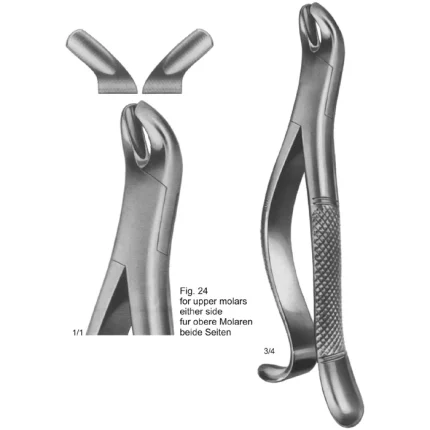
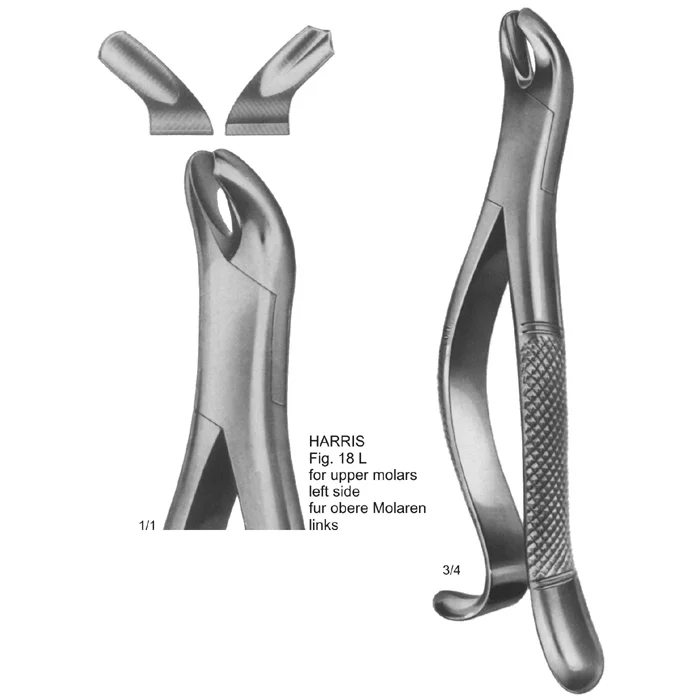
Harris Tooth Extracting Forceps
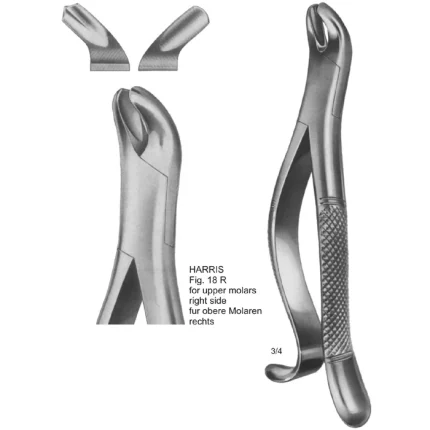
The ASI-2168 Harris Tooth Extracting Forceps, listed as Fig.18L in the American Pattern range, is purpose-built for one of the more demanding extraction sites in the mouth: the upper left molars. Where a universal forceps has to compromise its beak shape to work across multiple tooth types, this Fig.18L model is dedicated to that specific position, which lets the design commit fully to the crown and root geometry it needs to grip.
Manufactured by Aero Surgical Instruments in Sialkot, Pakistan, the forceps is machined from German-grade surgical stainless steel. That material choice underpins the instrument’s core job: withstanding the rotational and lever forces molar extraction demands without the beak tips flexing, twisting, or losing their bite mid-procedure. The same alloy composition, with its high chromium content, keeps the metal from rusting or pitting through years of sterilization exposure, which matters for a tool that a busy practice may run through an autoclave several times a day.
The beak design is the functional heart of this instrument. Shaped to match the crown contour of upper left molars specifically, the beaks are meant to seat around the tooth with minimal gap, translating hand force directly into elevation rather than losing it to slippage. A tighter anatomical match also tends to mean less repositioning during the procedure, which shortens chair time and reduces unnecessary stress on the surrounding periodontal ligament and alveolar bone — both of which affect how comfortably and quickly a patient heals afterward.
Handle construction follows the same practical logic as the rest of Aero Surgical’s American Pattern line. A cross-hatched, knurled texture covers the gripping surface, giving the clinician a stable hold even when gloves are damp with saliva or irrigation fluid — a detail that becomes more important, not less, during longer or more physically demanding molar extractions. The handle’s weight is balanced along the shaft to help preserve tactile feedback, so the operator can still sense how a root is responding to force rather than working “blind” through a heavy or poorly weighted tool.
Like the rest of the range, the ASI-2168 carries a dull matte surface finish rather than a bright polish. In an operatory under strong overhead lighting, a mirror-finish tool throws reflections back toward the clinician at precisely the moments fine visual control matters most; the matte coating is intended to minimize that distraction and keep the surgical field visually clear.
Being stainless surgical steel, the instrument is built to tolerate standard hospital sterilization workflows — steam autoclaving, ultrasonic cleaning baths, and chemical disinfection — without degrading the surface or loosening the hinge joint over repeated cycles. Its dimensions are consistent with standard dental tray and cassette setups, so it integrates into an existing extraction kit without requiring special storage accommodations.
Overall, the ASI-2168 / Fig.18L is a targeted, site-specific instrument rather than a general-purpose tool: it’s intended for practices and oral surgeons who extract upper left molars often enough that a dedicated, anatomically matched forceps offers a real advantage in grip security and procedural speed over a universal design.
Frequently Asked Questions:
- What tooth position is the ASI-2168 designed for? It’s built specifically for extracting upper left molars.
- What does “Fig.18L” refer to? It’s the instrument’s pattern-and-side designation — Figure 18, left side — used to distinguish it from mirrored right-side variants.
- What material is the forceps made from? German-grade surgical stainless steel.
- Who manufactures this instrument? Aero Surgical Instruments, based in Sialkot, Pakistan.
- What surface finish does it have? A dull, non-reflective matte finish rather than a polished chrome look.
- Why is a site-specific forceps better than a universal one? Its beak shape matches the target molar’s contour more closely, improving grip and reducing slippage.
- Can it be autoclaved? Yes, the stainless steel construction withstands repeated steam autoclave cycles.
- Is it safe for ultrasonic cleaning? Yes, it can be processed through standard ultrasonic bath cleaners.
- How does the handle prevent slipping? A cross-hatched, knurled texture keeps grip secure even with wet or gloved hands.
- Does the beak shape reduce risk to surrounding tissue? A close anatomical fit lowers the chance of slippage that could injure gum or bone tissue.
- Is this instrument suited for oral surgeons specifically? It’s suited to both general dentists and oral surgeons who regularly perform molar extractions.
- Will it fit standard dental sterilization trays? Yes, its dimensions match common dental cassette and tray layouts.
- How does the matte finish help during procedures? It reduces glare from operatory lighting, supporting clearer visibility in the surgical field.
- Does the forceps resist corrosion from disinfectants? Yes, the steel’s chromium content resists pitting and oxidation from standard chemical solutions.
- Is this the right forceps for lower molars? No, this model (Fig.18L) is specific to upper left molars; lower molars require a different pattern.
- Can this be used on the right side upper molars? No, it’s shaped for the left side; a mirrored right-side version is used for that position.
- What should be checked before each use? Hinge movement and beak alignment should be inspected to confirm smooth, secure closure.
- Is the instrument reusable? Yes, it’s designed as a durable reusable tool for repeated sterilization and use.
- Does the design help reduce hand fatigue? Balanced weight distribution along the shaft is intended to ease strain during longer procedures.
- Is this forceps appropriate for pediatric patients? No, it’s sized for adult molar extractions; pediatric cases require smaller pattern instruments.